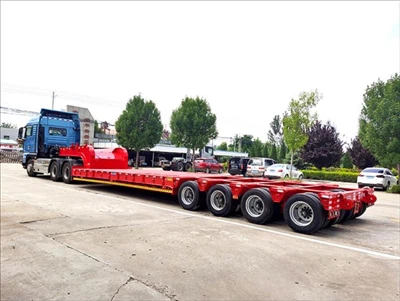
Core Content Analysis
(1) Market Distribution: Led by Three Major Sectors, Emerging Markets Rising
The global semi-trailer export market has formed a three-legged pattern of "mature European and American markets + core Asia-Pacific markets + potential emerging markets", with significant differences in demand characteristics across regions:
• Mature European and American Markets: Dominated by equipment renewal demand, with strict requirements on product safety, environmental protection, and intelligent standards. Driven by the "Fit for 55" emission reduction plan, EEV-certified models account for 73% of the European market. Countries such as Germany and the Netherlands prefer low-floor semi-trailers and modular combined models, and the pilot policy for Longer Heavier Vehicles (LHV) has promoted the application of high-strength materials. The North American market has a mature trunk line logistics system, with van semi-trailers accounting for over 60%. The annual growth rate of refrigerated semi-trailers reaches 5.8%, and the US IRA Act provides a new energy subsidy of 40,000 US dollars per vehicle, accelerating the popularization of electric semi-trailers.
• Core Asia-Pacific Markets: China and India are the main growth engines, radiating cross-border logistics demand in Southeast Asia. As a production and export hub, China had a stock of over 7 million semi-trailers in 2025, with industrial clusters formed in Shandong, Hebei and other regions, and its products have significant cost-performance advantages. Benefiting from manufacturing transfer and infrastructure investment, the ratio of tractor units to semi-trailers in Southeast Asian markets such as Vietnam and Indonesia will increase from 1:1.2 to 1:1.5, leading to strong demand for cross-border skeleton semi-trailers.
• Potential Emerging Markets: Africa and the Middle East have become new growth points. Driven by Chinese-funded infrastructure projects, the compound annual growth rate of imports of special semi-trailers in African countries such as Nigeria and Kenya reaches 18.4%. Focusing on smart logistics upgrading, the Middle East market has invested 7.2 billion US dollars in building logistics infrastructure under Saudi Arabia's "Vision 2030", and the installation rate of digital management systems will exceed 75%.
(2) Policy Impact: Two-way Drive, Compliance as a Prerequisite
The semi-trailer export industry is subject to dual constraints of domestic and foreign policies, and policy orientation directly determines market access and competitive pattern:
• Domestic Support Policies: The "14th Five-Year Plan for Modern Logistics Development" clearly promotes the standardization and lightweight development of semi-trailers. The Ministry of Industry and Information Technology requires that the average curb weight of semi-trailers in 2027 be reduced by 8% compared with 2020, and the penetration rate of aluminum alloy semi-trailers be increased to over 25%. The Belt and Road Initiative has driven the construction of the New International Land-Sea Trade Corridor in western China, and the scale of the semi-trailer leasing market in southwest China will reach 48 billion yuan by 2030, providing regional synergy opportunities for export enterprises. In addition, customs policies such as the "Spring Breeze for Enterprises" and export tax rebate counseling have reduced the foreign trade costs of enterprises. Yuncheng County has helped semi-trailer enterprises connect directly with overseas markets through a model of government matchmaking + state-owned enterprise support + platform navigation, avoiding intermediary premiums.
• International Regulatory Policies: Environmental protection and safety regulations have become major thresholds. The EU's Carbon Border Adjustment Mechanism (CBAM) to be implemented in 2026 will increase the cost of exported semi-trailers by 8%-12%, and new semi-trailers sold from 2025 must meet stricter rolling resistance standards. The US FMCSA has strengthened vehicle safety certification, and Electronic Braking Systems (EBS) and Advanced Emergency Braking Systems (AEBS) have become standard equipment. Some countries have implemented localization policies, such as Southeast Asia requiring a KD assembly capacity utilization rate of over 80% to enjoy tariff preferences, forcing enterprises to layout overseas production bases.
(3) Technical Requirements: Integration of Three Modernizations, Details Determine Competitiveness
Technological upgrading is the core to breaking through market barriers, and exported semi-trailers need to meet the triple requirements of "compliance + adaptability + advancement":
• Lightweight Technology: The application ratio of high-strength steel, aluminum alloy, and composite materials has become a key indicator. Currently, the average industry application ratio is 35%, and leading enterprises have increased it to over 50%. A 15%-20% weight reduction per vehicle can significantly reduce fuel consumption and carbon emissions, and the EU has clearly included vehicle weight into the environmental protection assessment system. For example, Shandong Luoxiang adopts aluminum alloy frames and air suspension, and the weight of its products is 2 tons lower than that of traditional models, with a premium of 15% in the European market.
• Intelligentization and Connectivity: Tire Pressure Monitoring Systems (TPMS), remote diagnosis, and RFID cargo tracking systems have become standard equipment in the high-end market. By 2030, 68% of newly sold semi-trailers worldwide will be integrated with Internet of Vehicles (IoV) functions. The EU mandates that all semi-trailers be equipped with AEBS systems by 2027, driving the scale of the relevant modification market to 8.4 billion euros. The intelligent container semi-trailer launched by China National Heavy Duty Truck Group (CNHTC) is equipped with automatic locking devices and route optimization systems, and is widely favored in cross-border transportation in the RCEP region.
• Specialized Adaptability: Segmented markets have significant differences in technical parameter requirements. Cold chain semi-trailers need to meet precise temperature control from -25℃ to +25℃. Germany's Schmitz Cargobull eCool series electric refrigerated semi-trailers have a cruising range of 200 kilometers, adapting to zero-emission distribution in European cities. Wind power equipment transport vehicles need to be equipped with hydraulic lifting systems, and the hydraulic configuration rate of 90-meter blade transport vehicles has increased from 58% to 82%. Dangerous goods transport semi-trailers must be equipped with emergency shutdown devices, and new energy-powered models are being piloted and promoted in 15 provinces, with LNG-powered tank trucks accounting for 18%.
(4) Risk Response: Multi-dimensional Prevention and Control, Steady Expansion Overseas
Semi-trailer exports involve multiple risks such as supply chain, policy, and market, requiring the establishment of a full-process prevention and control system:
• Response to Trade Barriers: In response to barriers such as carbon tariffs and technical certification, enterprises can adopt a dual strategy of "localized production + technological upgrading". For example, Chinese enterprises have laid out KD factories in Vietnam, exporting parts for assembly before selling to Europe to avoid additional CBAM costs. CIMC Vehicles has obtained EU ECE R132 certification, and its lightweight semi-trailers directly meet carbon emission requirements without additional rectification.
• Supply Chain Risk Prevention and Control: Price fluctuations of raw materials such as steel and aluminum can be controlled through long-term agreements. After steel prices rose by 36% in 2023, leading enterprises had a gross profit margin 5-8 percentage points higher than that of small and medium-sized manufacturers due to signing annual procurement contracts in advance. At the same time, it is necessary to establish an alternative supply system for parts, such as prioritizing international brands such as Bosch and Wabco for ABS systems to avoid delivery delays caused by supply disruptions from a single supplier.
• Market Adaptability Risk: Conduct in-depth research on the regulatory and demand differences of target markets in advance to avoid "one-size-fits-all" exports. For example, the African market has high requirements for load-carrying capacity but poor road conditions, so enterprises can strengthen frame strength and increase tire thickness. The Middle East market has high temperatures and dry conditions, requiring optimization of the heat dissipation performance of the braking system and the circuit protection level. Through participating in overseas exhibitions and direct docking with foreign merchants, enterprises in Yuncheng accurately grasped demand pain points and secured 2.2 million US dollars in intentional semi-trailer orders during the 2024 Canton Fair.
• Financial and Compliance Risks: Use export credit insurance to cover political risks and accounts receivable risks, and adopt letter of credit settlement to reduce payment risks. At the same time, establish a compliance team to track changes in tariff policies and certification standards of target countries. For example, after the EU revised heavy-duty vehicle emission standards, enterprises completed product upgrades 6 months in advance without affecting order delivery.
III. Industry Outlook
The semi-trailer export industry is in a critical period of high-quality development, and the improvement of global logistics efficiency and green transformation provide broad space for the industry. In the future, enterprises with "technological upgrading capabilities, market adaptability capabilities, and risk prevention and control capabilities" will occupy a competitive advantage. For practitioners, it is necessary to closely follow policy orientations and technological trends, deepen segmented markets, and enhance brand voice through product innovation and service upgrading. Foreign trade practitioners can rely on the advantages of industrial belts to build channels directly connecting overseas, helping enterprises transition from "going global by borrowing ships" to "sailing global independently". With the restructuring of the global supply chain and the advancement of the intelligent wave, the semi-trailer export industry will continue to release value potential and become a core link connecting domestic and foreign logistics networks.